
The 15-Minute Skill Stacking Method: How to Build Career-Changing Skills in 30 Days
If someone told you that you could build career-changing skills in just 15 minutes a day, you’d probably assume they were selling you something—until you see the neuroscience behind it.

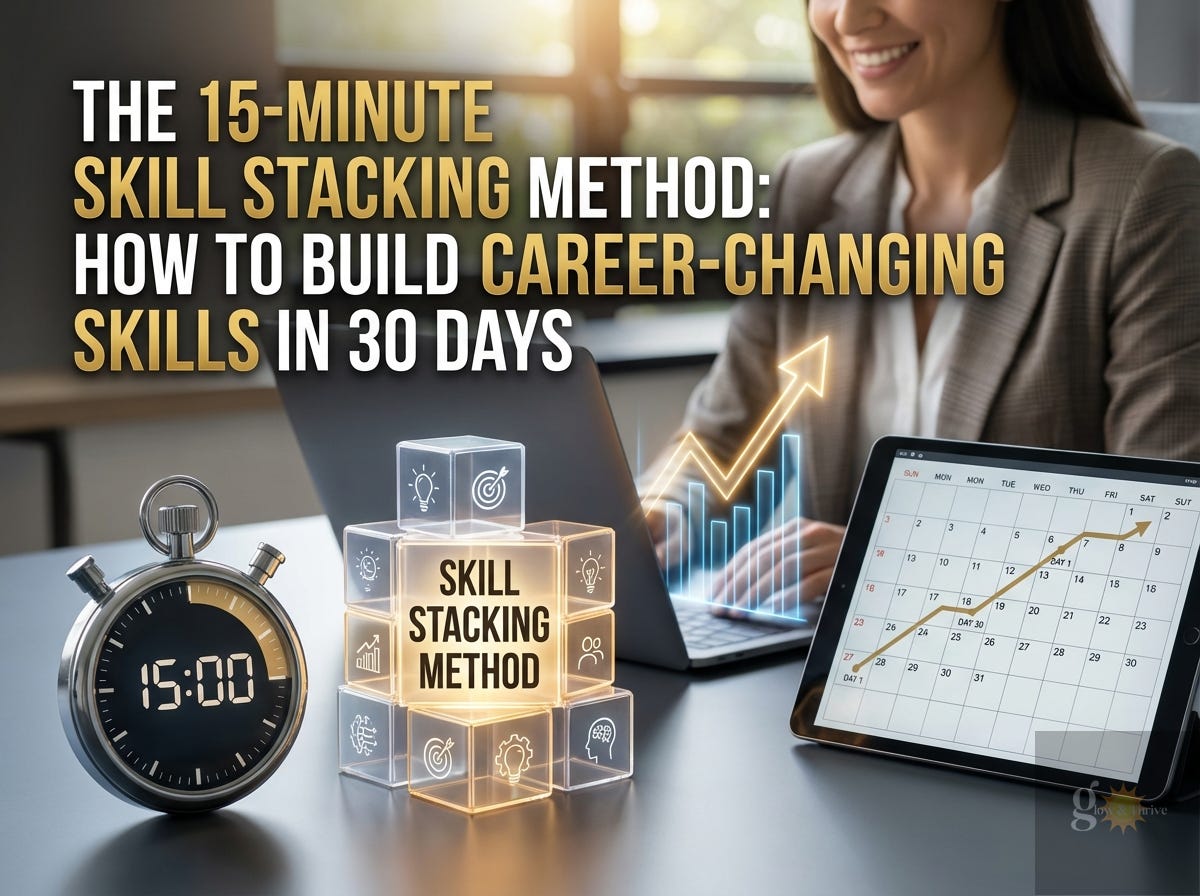
There’s a quiet revolution happening in the way professionals learn—and most people haven’t caught up yet.
For decades, “serious” skill building meant long courses, expensive bootcamps, or weekends lost to 12-hour study marathons. But the professionals who are actually rising—landing promotions, changing careers, and becoming indispensable—aren’t studying harder.
They’re studying smarter.
And the method they’re using is shockingly simple: skill stacking, powered by 15-minute micro-learning bursts that fit into even the busiest day.
This isn’t productivity hype. This is neuroscience, executive training methodology, and modern career strategy rolled into one elegant system that Fortune 500 companies quietly use to upskill their leaders.
And yes—it works even if you feel tired, burned-out, overwhelmed, or stuck in a role you’ve outgrown.
Let’s break down how it works, what it can do for your career, and how you can start today.
What Is Skill Stacking—and Why Is It Replacing Traditional Learning?
Traditional learning assumes the more hours you put in, the more expertise you gain.
But in practice, most professionals don’t have hours. You may work full-time, care for kids, manage a household, or simply not have the bandwidth to immerse yourself in 40-hour courses.
Skill stacking solves this.
Instead of forcing yourself to master one large, intimidating skill (like “data analysis” or “project management”), you learn micro-skills that layer together like building blocks—creating a powerful, career-changing skill set without burnout.
A few examples:
Instead of “I need to learn digital marketing,” you build:
SEO basics → copywriting → analytics → automationInstead of “I need leadership skills,” you stack:
communication → conflict resolution → team motivation → decision-makingInstead of “I need to learn design,” you stack:
visual hierarchy → color theory → typography → layout composition
No one micro-skill is overwhelming. But together, they change your career trajectory.
This is how modern, high-achieving professionals grow fast—while everyone else still feels stuck, convinced they “don’t have time.”
⭐ The 15-Minute Skill Stacking Framework (The Method That Actually Works)
This is where it gets beautifully simple.
Every day—just 15 minutes, no more—you follow this flow:
Minutes 1–3: Focused Input (Short, targeted learning)
You learn just one small, concentrated piece of information:
One short tutorial
One targeted article
One mini-lesson
One concept explained in under 3 minutes
You’re not reading big books.
You’re not watching long videos.
You’re learning one thing you can do.
This gets your brain ready. Research from the University of California Irvine shows quick learning sticks better than long sessions.
Minutes 4–12: Active Practice (Where the magic happens)
Now, use what you learned.
This step is often skipped.
Practice can be:
writing a sample paragraph using a new copywriting formula
analyzing a tiny dataset
designing a 3-slide mockup
running one SQL query
sketching a wireframe
building a small automation
creating a social post using a new content framework
The goal isn’t to be perfect.
It’s activation—making what you learned real.
A 2019 Stanford study found quick practice boosts retention by up to 400%. That’s why the 15-minute method works.
Minutes 13–15: Reflection + Tomorrow’s Plan
Finish with two questions:
What did I learn today?
What is the next small skill I should stack?
Write it down. Document it. This turns your brain from consumer → creator → strategist.
This is how you grow faster than traditional studying.
⭐ The Science Behind This Method (Why Micro-Learning Outperforms Cramming)
Micro-learning fits how we learn best. Why?
1. The brain retains small information chunks better
Research shows we learn faster with small, focused info. Our brain can handle it better.
2. Repetition strengthens neural pathways
Short bursts help create strong habits. This is how we learn language and sports.
3. Tiny wins keep motivation alive
Dopamine goes up with quick wins. Not with big, hard tasks.
4. Daily exposure creates compound learning
Like investing, daily learning adds up.
15 minutes × 30 days = 7.5 hours of quality learning.
This is more than most do in a month of trying.
The High-Demand Skill Stacks for 2024–2025
Here are skill stacks for today’s jobs. Each is broken into four weeks of micro-skills for the 15-minute method.
⭐ 1. The Digital Marketing Skill Stack
Week 1: SEO basics, keyword research
Week 2: Copywriting & content frameworks
Week 3: Analytics, data interpretation
Week 4: Email automation & campaign structure
Great for: creators, small business owners, virtual assistants, freelancers.
⭐ 2. The Data Analysis Skill Stack
Week 1: Excel/Sheets advanced formulas
Week 2: Data visualization
Week 3: SQL basics
Week 4: Dashboard design
Perfect for: career changers, analysts, anyone seeking high-paying roles.
⭐ 3. The Leadership Skill Stack
Week 1: Communication frameworks
Week 2: Conflict resolution
Week 3: Team motivation techniques
Week 4: Decision-making models
Perfect for: managers, soon-to-be leaders, entrepreneurs.
⭐ 4. The Creative Problem-Solving Stack
Week 1: Design thinking
Week 2: Brainstorming systems
Week 3: Systems thinking
Week 4: Innovation methodologies
Perfect for: product, creative teams, strategists, innovators.
⭐ How to Choose Your Skill Stack (and Stick to It)
Use this 5-step plan:
Pick a skill stack aligned with your next career move
Find 3–5 trusted learning sources
Dedicate a consistent daily 15-minute slot
Track progress in a simple skill journal
Share what you’re learning (LinkedIn posts = career visibility)
⭐ How to Measure Progress (So You Know It’s Working)
Week 1: You can explain what you’re learning
Week 2: You can apply the basics
Week 3: You can teach the skill or create content
Week 4: You can combine multiple skills to create value
This is the difference between dabbling and becoming employable.
Final Thoughts: The 30-Day Transformation Is Real
You don’t need five-hour study sessions, expensive certifications, or perfection.
You need 15 minutes of deliberate practice, every day.
If you follow this method, here’s what happens:
skills compound
confidence strengthens
opportunities start appearing
your LinkedIn grows
recruiters take notice
you become undeniable
And it all starts with a tiny, manageable daily habit—one that respects your energy, your schedule, and your real life.